Five reports · Report 01
Roof space · after darkPossums in the roof
You may trap a common brushtail possum that is living in your building, but only in a trap that will not injure it, and you must let it go on the same property within 50 metres of where you caught it. Taking it further away, or off the property, is prohibited in Victoria, so the real work is making the roof a place it cannot get back into.
General information about Victoria’s rules, not legal advice. The Victorian Government’s brushtail possum page, listed at the foot of this page, is the place to check.
- Season
Any: the guidance names none
- Hours
Night: active after dark, resting by day
- Ground
Between the ceiling and the roof
- Office
Victoria’s wildlife rules
First, be sure it is a possum
Rats get into roofs too, and the Victorian page asks you to check before you do anything. The sounds differ: rats make light scampering and gnawing noises, while a possum hisses from the throat and thumps heavily. If it is rats, a licensed pest control operator can help; getting ready for a treatment explains what to expect.
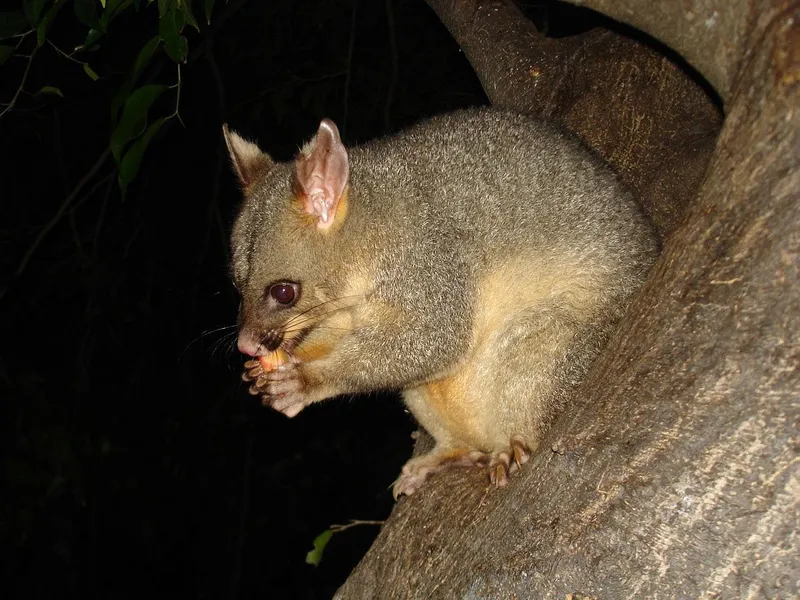
The common brushtail is the most abundant possum in Australia and close to the size of a small cat, with grey fur and a darker, thick, bushy tail. It rests in secure, dark, dry places such as hollows, rock cavities and roofs, and in towns it is more abundant than in native habitat. In a house it usually makes its den in the gap between ceiling and roof, and the noise and mess come with it. It may also damage the garden and eat your pets’ food.
Why the rules are tight
Possums are protected under Victoria’s Wildlife Act 1975. The state’s health department sums up that Act: without prior written approval from the Secretary of the environment department, it is an offence to take, keep, control, kill or release wildlife, among a long list of other acts. All Victorian native wildlife is protected, and harassing or harming native animals without authorisation is illegal.
The trapping permission for brushtails in buildings comes from a Governor in Council Order, and it is narrow.
What the Order allows
- Residents and land managers may humanely trap a common brushtail possum living in a building.
- The trap must be one that will not injure the possum.
- Release on the same property, within 50 metres of where it was caught.
What it prohibits
- Moving the possum more than 50 metres from where it was caught.
- Moving it off the property where it was caught.
The reason is the possum’s own: research shows brushtails released somewhere new are often distressed, attacked by other possums, and may die.
The City of Casey puts the trap point plainly: you cannot harm or capture a possum without a proper trap. Humane traps can come from your local council, or be hired from licensed wildlife controllers.
Closing the roof behind it
Trapping alone is not the end of it. Victoria’s advice is that a brushtail in a roof should be removed humanely and kept from returning. The page’s suggestions, gathered for a roof:
- Find the way in
Brushtails find their way into roof spaces via loose tiles or iron, broken eaves, and holes in brickwork or timber. Note where the possum comes out, then block those points.
- Let it out, not back
A one-way flap lets a possum leave but not return, and the page calls it a simple, humane way to restrict access.
- Cut the bridge
Prune every branch that leads to the roof and leave a gap of at least 1.5 metres. Possums can jump a long way down, but not far across.
- Offer another bed
A nest box in the garden gives it another den. Brushtails are territorial, so one that adopts the box will keep others away from your property.
In the garden and along the fence
Where possums damage trees badly or reach the roof from a tree, a Perspex or metal collar 60 centimetres wide around the trunk stops them climbing it. To keep them off the property, the page describes a floppy boundary fence 30 centimetres high built on top of an existing fence, or a low-powered electric fence that deters them without harm.
Repellents and ultrasonic devices do little to deter brushtail possums.
When someone else does it
You can hire a professional to remove possums. For the pest control industry, the licence category that covers removing, destroying or disposing of native fauna is the Wildlife Controller category. Victoria’s health department lists that licence as one issued under wildlife legislation by the state’s environment department, which its page names as the Department of Environment, Land, Water and Planning (DELWP).
On your own land a wider principle holds: managing the risks wildlife causes on a piece of land is the job of its land manager. If you live in a block with common property, owners corporations and pests covers who looks after it.